

Theravāda Forest Monastery · Mysore, Karnataka
Dedicated to the study, practice, and teaching of the Dhamma
as preserved in the Sutta-Piṭaka and the Vinaya-Piṭaka.
Welcome
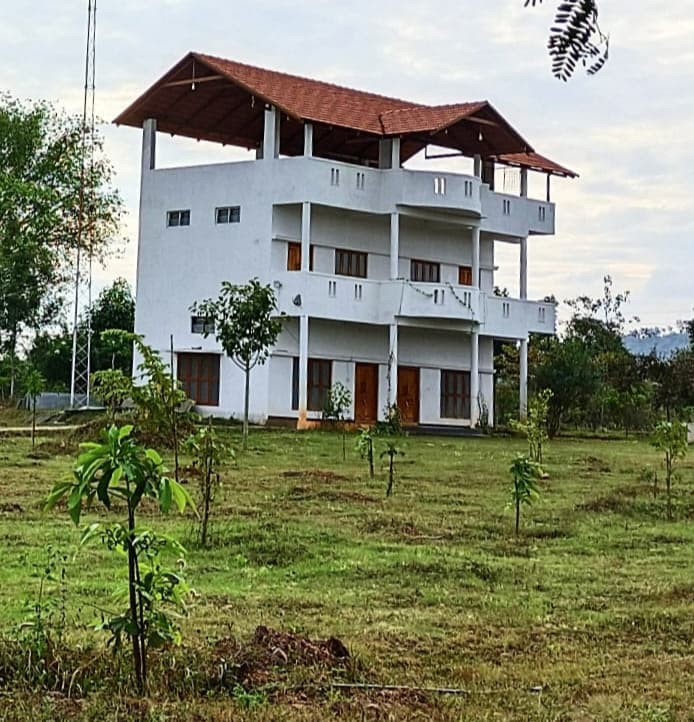
The monastery provides a peaceful environment where monastics and lay practitioners can develop their understanding and practice of the Buddha's teachings through meditation, Dhamma study, mindful living, and monastic training.
12
acres of land
3,000+
trees planted
30
international standard rooms
2
bhikkhu dwellings (kutis)
Explore
Come, see, and practise
From the guiding bhikkhu
Namo tassa bhagavato arahato sammāsambuddhassa.
Dear fellow meditators,
Have you ever wondered why the sitting meditation you do seems to end on the cushion — why the benefits do not seem to carry into ordinary life?
Let me explain why that can happen.
Often we treat meditation as something separate from daily activity. A kind of wall goes up between “practice” and “life.” In practice, the two are better brought together — like milk and sugar — so that meditation can offer lasting benefit.
Here is a further question: why should the same meditation be given to different people with different temperaments and difficulties? The Buddha himself offered different approaches to different people.
For example: two people, A and B — one tends toward anger, the other toward fear. Can one identical technique address both in the same way? Is that realistic?
And even for one person: if different defilements arise at different times, need the response always be identical?
Consider a simple parallel.
At one moment a person is caught by anger; at another, by fear. The shape and causes of those states are not the same — so the skilful response may not be the same either.
You may also notice bodily reactions during practice. Those reactions are usually effects, not the causes of fear, anger, or jealousy. The movement of mind is where the work begins.
Here is another illustration.
A person, Sid, has fever and pain. In one case, a doctor treats the symptoms with paracetamol; the discomfort eases for a while. In another, a doctor investigates, finds malaria, and treats the disease itself with something such as quinine.
In both situations Sid feels relief — but not in the same way.
Symptomatic relief can be temporary: when the medicine wears off, fever and pain may return. Treating the underlying cause aims at something more stable.
Turn it around once more.
Quinine helps malaria; it is not the right response for jaundice. Meditation, too, is not one fixed pill for every condition.
So “one size fits all” is a weak model for spiritual training — just as it is for medicine.
It is worth asking whether what you practise actually moves toward freedom (nibbāna), whether it addresses root causes rather than only surface agitation, and whether it truly meets your situation — or has become mechanical.
Lay life is full of duties and short on time. The little time you have for practice is precious; it is worth using it in a way that accords with the Buddha's path.
With mettā for all,
Bhikkhu Bodhi Dhamma
Daily Schedule
Live the Training
The daily routine provides structure for meditation, study, work, rest, and other monastic responsibilities.
It is to train the mind to live with awareness, discipline, and purpose.
Becoming a MonkEarly Morning
Wake up • Meditation • Morning duties
Morning
Dhamma/Vinaya study • Alms/meal • Monastic responsibilities
Afternoon
Meditation • Study • Work/service • Individual practice
Evening
Meditation • Dhamma reflection • Community responsibilities
Night
Rest and preparation for the following day
The gift of the Dhamma excels all other gifts.
Dhammapada 354
Updates
Monastery updates
Building progress and short reports from the grounds.
Gallery
Moments & reflections
Dhamma reflections and photographs from the monastery, retreats and courses.